
Does the European Accessibility Act Apply to UK Businesses?
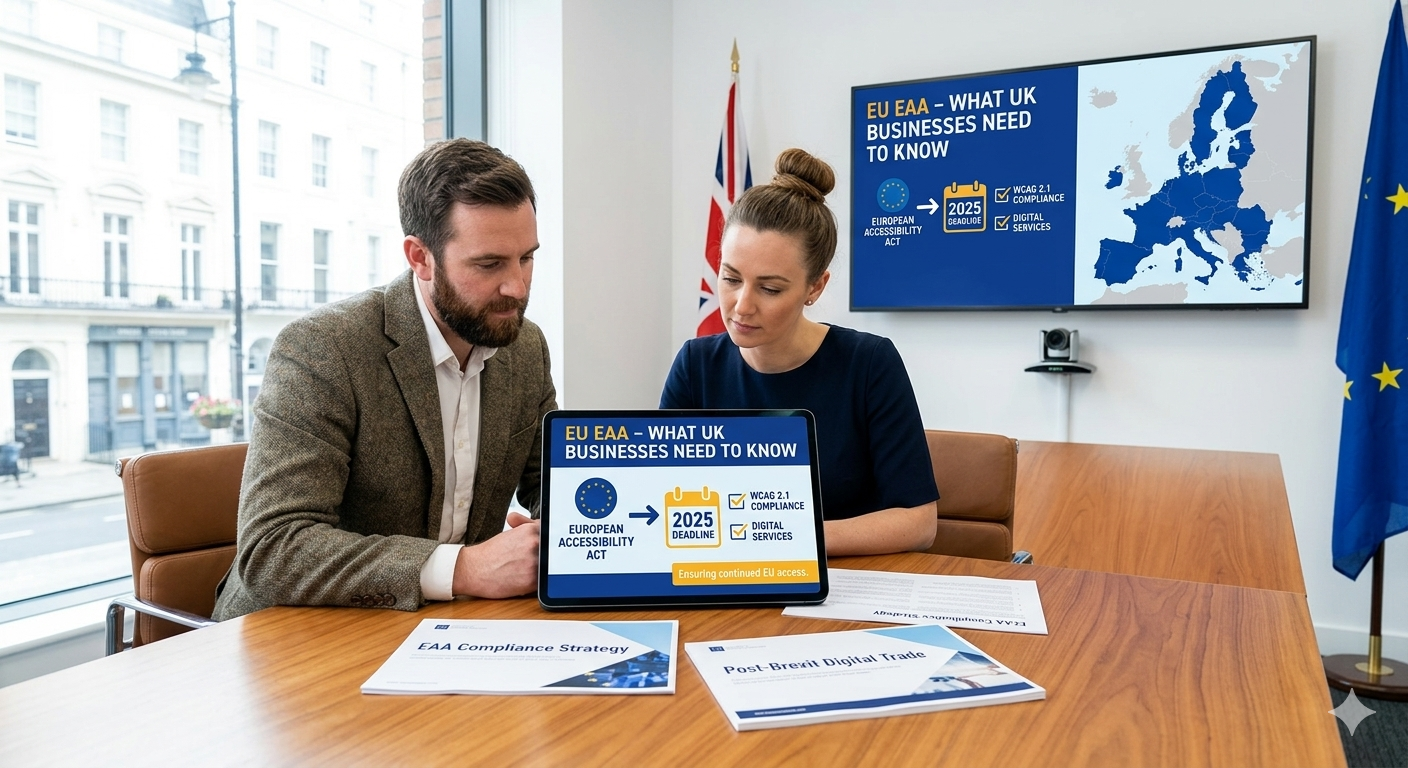
The short answer: yes, if you sell to EU consumers.
The European Accessibility Act (Directive 2019/882) became applicable on 28 June 2025. It requires certain digital products and services sold to consumers in the EU to be accessible. Brexit does not change this — if your customers are in the EU, the EAA applies to you.
This is the same principle as GDPR. A UK company processing EU residents' data must comply with EU data protection law. A UK company selling digital services to EU consumers must comply with the EAA.
What the EAA covers
The EAA applies to specific categories of digital products and services:
- E-commerce — if you run an online store that sells to EU customers, your store must be accessible
- Banking and financial services — online banking, payments, credit agreements
- Telecommunications — calls, messaging, internet access
- Transport services — online booking, mobile apps, real-time passenger information
- E-books — distribution platforms and reading applications
- Computing hardware — computers, smartphones, tablets, self-service terminals
If your business provides any of these to EU consumers, the EAA requires you to meet the accessibility requirements — regardless of where your business is registered.
What UK law already requires
Even without the EAA, UK businesses already have accessibility obligations:
The Equality Act 2010
The Equality Act places a duty on all service providers to make reasonable adjustments for people with disabilities. This duty is anticipatory — you must address barriers proactively, not just after someone complains.
While the Equality Act does not specify a technical standard, courts and the Equality and Human Rights Commission reference WCAG 2.1 Level AA as the benchmark for what constitutes a reasonable adjustment for websites.
Public Sector Bodies Regulations 2018
UK public sector bodies must ensure their websites and mobile apps meet WCAG 2.1 AA and publish an accessibility statement. The Government Digital Service (GDS) monitors compliance.
EAA vs UK law — what's the difference?
| Aspect | European Accessibility Act | UK Equality Act 2010 |
|---|---|---|
| Scope | Specific product and service categories | All service providers (broad duty) |
| Technical standard | EN 301 549 / WCAG 2.1 AA (explicit) | WCAG 2.1 AA (via case law, not explicit in statute) |
| Applies to | Anyone selling covered products/services to EU consumers | UK service providers |
| Private sector | Yes — specific requirements per product/service type | Yes — "reasonable adjustments" duty |
| Documentation | Technical documentation + EU declaration of conformity (products) | Accessibility statement (public sector only) |
| Enforcement | National market surveillance authorities in each EU member state | Equality and Human Rights Commission |
| Penalties | "Effective, proportionate, and dissuasive" (Article 30) — varies by country | Discrimination claims, compensation awards |
| Micro-enterprise exemption | Yes (services only, <10 employees, <€2M turnover) | No blanket exemption |
The practical difference: the Equality Act is broad but vague ("reasonable adjustments"), while the EAA is narrow but specific (named product/service categories with explicit technical standards). If you sell to both UK and EU customers, you effectively need to meet both.
Does the EAA apply to B2B?
The EAA primarily targets consumer-facing (B2C) products and services. Pure B2B services are generally outside scope.
However, the boundary is not always clear:
- If a platform serves both businesses and consumers, the consumer-facing elements must comply
- If your B2B product is resold to consumers by your client, the end-product must comply
- Self-service terminals (ATMs, ticketing machines) must comply regardless of the business model
When in doubt, treat it as in scope. The cost of compliance is almost always less than the cost of a legal challenge.
What UK businesses need to do
1. Determine if you're in scope
Do you sell any of the covered products or services to consumers in the EU? If yes, the EAA applies to those products and services. Check the full list of covered categories.
2. Assess your current state
Request a free accessibility report from Askem — enter your website URL and email, and we'll send you a WCAG analysis within 24 hours. The report shows where you stand against WCAG 2.1 AA, the standard both the EAA and UK law reference.
3. Conduct a thorough audit
An automated check covers roughly 30–40% of WCAG criteria. Use our EAA compliance checklist to assess your organisational readiness, then supplement with a manual accessibility audit for key user journeys — especially checkout, registration, and payment flows if you run an e-commerce operation.
4. Set up continuous monitoring
Askem's quality assurance monitors your site automatically and alerts you when accessibility issues appear. This is especially important if you serve both UK and EU markets — one set of monitoring covers both legal frameworks, since the technical requirement (WCAG 2.1 AA) is the same.
Askem's feedback tool also collects user feedback directly from your pages — so you hear about barriers from real users, not just from regulators.
The bottom line
Brexit did not create an accessibility exemption. If you sell digital products or services to EU consumers, the EAA applies. And even for purely UK-facing businesses, the Equality Act already requires accessible websites.
The good news: both frameworks point to the same standard — WCAG 2.1 AA. Fix it once and you're covered for both.
Request a free accessibility report from Askem — enter your URL and email, and we'll send you a WCAG analysis within 24 hours. Free, no commitment.